Challenge A: Comic
Dispersion of White Light
Updated: 25th September 2025
Author: Kushank Virdi
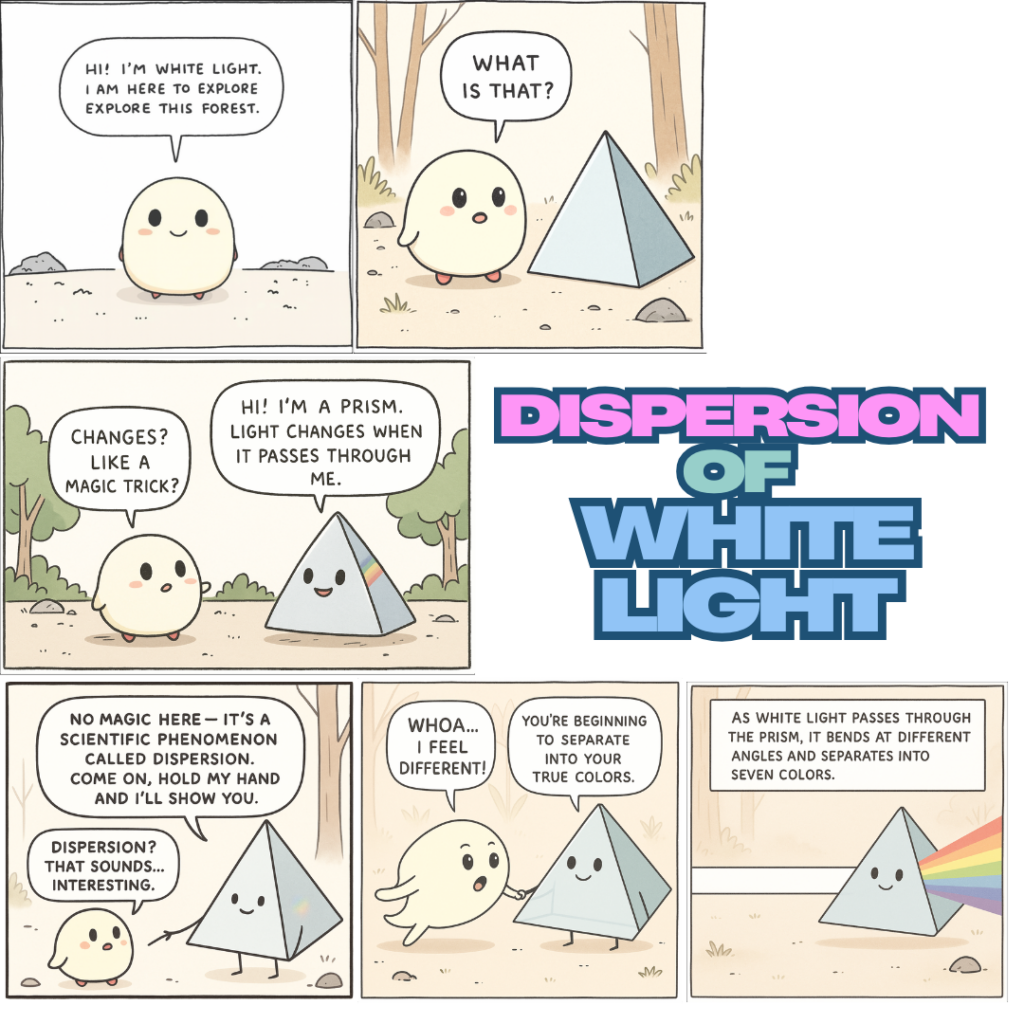
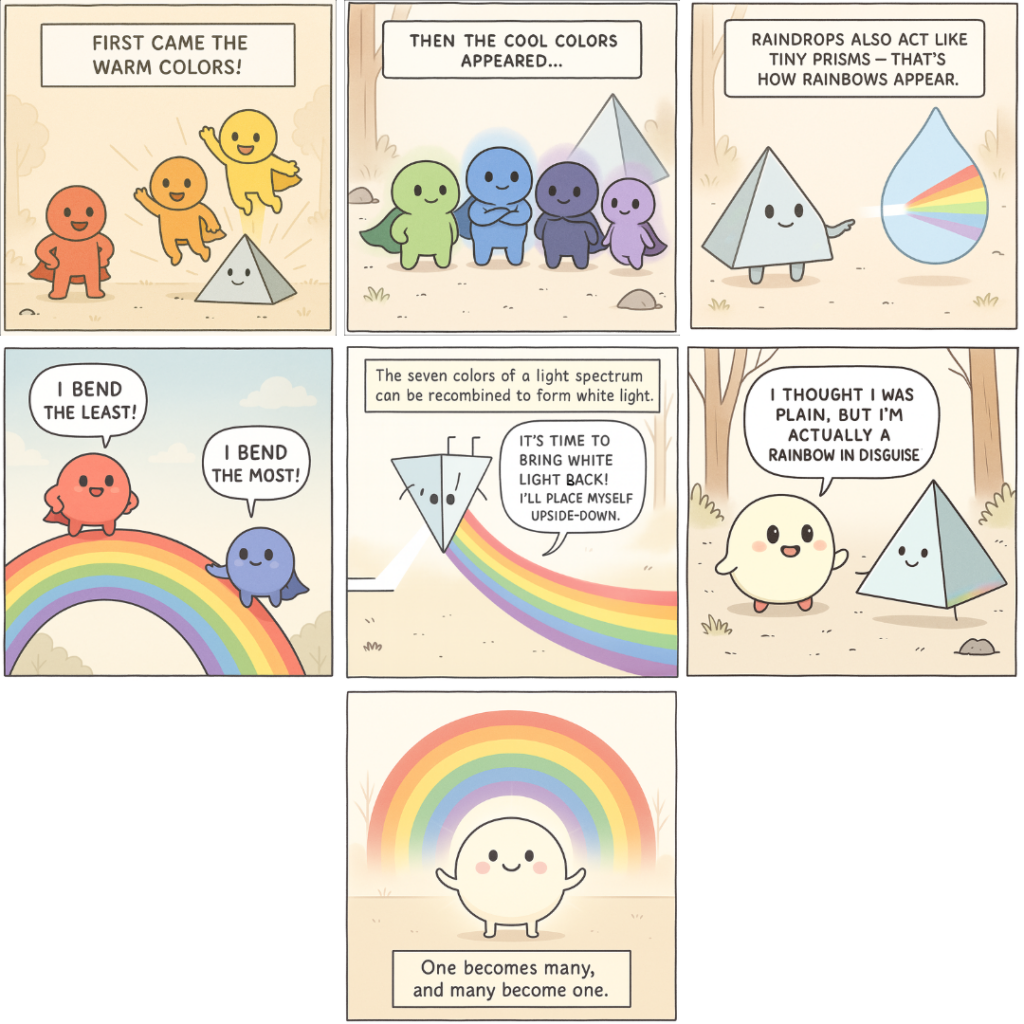
*Every Panel(13 in total) is a separate image that I created using ChatGPT(Panel 2-13) and Canva’s Image Generator(Panel 1).
Then I used Canva to arrange these panels on pages to create a comic.*
Please refer to the IMAGE GENERATION and References section at the end to learn more about prompt, version etc
THE PROCESS
Understand (Discover, Interpret, Specify)
DESCRIBE THE CHALLENGE:
Many people struggle to understand why white light is not just “plain,” but actually a combination of multiple colors which can be demonstrated using dispersion. The concept of dispersion can feel abstract when presented only as a diagram. This comic uses simple characters (White Light, Prism, and the seven colors) to make the phenomenon easy, engaging, and memorable.
CONTEXT AND AUDIENCE:
The audience for this comic could be anyone who has ever wondered “Why do I see a rainbow?” or is curious about the basics of physics and optics.
The format appeals to a wide range of readers—from children learning science for the first time, to adults who enjoy fun explanations of everyday phenomena. Visual cues (like White Light stretching, splitting, and transforming into colors) make the invisible process tangible. Humor and personification reduce intimidation while keeping the material engaging.
This broad approach means the comic works both as an educational resource and as a playful way to satisfy natural curiosity about the world.
POV STATEMENT:
Learners who see light as something “plain” need to experience how mediums such as prisms/raindrops reveal its hidden colors, so they can better understand the concept of dispersion and connect it to real-world rainbows.
LEARNING OBJECTS:
Primary Objectives
- Learners can explain that white light is made of seven colors.
- Learners understand that recombining the seven colors produces white light.
- Learners can define dispersion as the bending of light at different angles through a prism/raindrops.
- Learners can connect dispersion to real-world phenomena like rainbows.
Sub-Objectives
- Learners recognize that each color bends differently (red least, violet most).
- Learners retain the concept more easily through character-driven storytelling and visuals.
Plan (Ideate, Sketch, Elaborate)
IDEATION:
I considered different approaches to teaching dispersion:
- A diagrammatic, science-textbook style explanation.
- A real-world rainbow example.
- A character-driven narrative (personifying elements in my story).
I chose the character-driven story because it makes the concept approachable and fun. White Light begins as a “plain” character, unsure of itself. The Prism introduces dispersion, guiding White Light through the transformation. The seven colors emerge as distinct personalities, introducing the concept of the visible spectrum. Finally, the comic ties dispersion to rainbows and shows that combining colors returns to white light.
This structure helps readers follow the science in a step-by-step manner while staying engaged.
STORYBOARD:
Panel 1
Visual: White Light introduces itself/Walks through the trees.
Text: “Hi! I’m White Light. I’m here to Explore this Forest”
Panel 2
Visual: White Light sees the Prism.
Text: “What is that?”
Panel 3
Visual: Prism introduces itself.
Text: “Hi! I’m a Prism. Light changes when it passes through me.”
White Light: “Changes? Like a magic trick?”
Panel 4
Visual: Prism reaches out.
Text: Prism: “No magic here — it’s called dispersion. Come on, hold my hand and I’ll show you.”
White Light: “Dispersion? That sounds… interesting.”
Panel 5
Visual: White Light halfway inside Prism, stretching.
Text: White Light: “Whoa… I feel different!”
Prism: “You’re beginning to separate into your true colors.”
Panel 6
Visual: White Light fully splits into 7 beams.
Narration: “As White Light passes through the prism, it bends at different angles and separates into 7 colors.”
Panel 7
Visual: Seven colorful characters wave.
Narration: “These colors together are called the spectrum of light.”
Panel 8
Visual: Prism comes and explains that the same effect happens in raindrops and relates it to rainbows.
Narration: “Raindrops act like tiny prisms — that’s how rainbows appear.”
Panel 9
Visual: Red and Violet at ends of rainbow.
Narration: “Red bends the least, Violet bends the most.”
Panel 10
Visual: The prisms tells that it’s time to bring the white light back and places itself upside down.
Narration: “When the 7 colors combine, they appear white.”
Panel 11
Visual: White Light reappears smiling.
Text: “I thought I was plain, but I’m actually a rainbow in disguise!”
Panel 12
Visual: White Light and spectrum together.
Narration: “One becomes many, and many become one.”
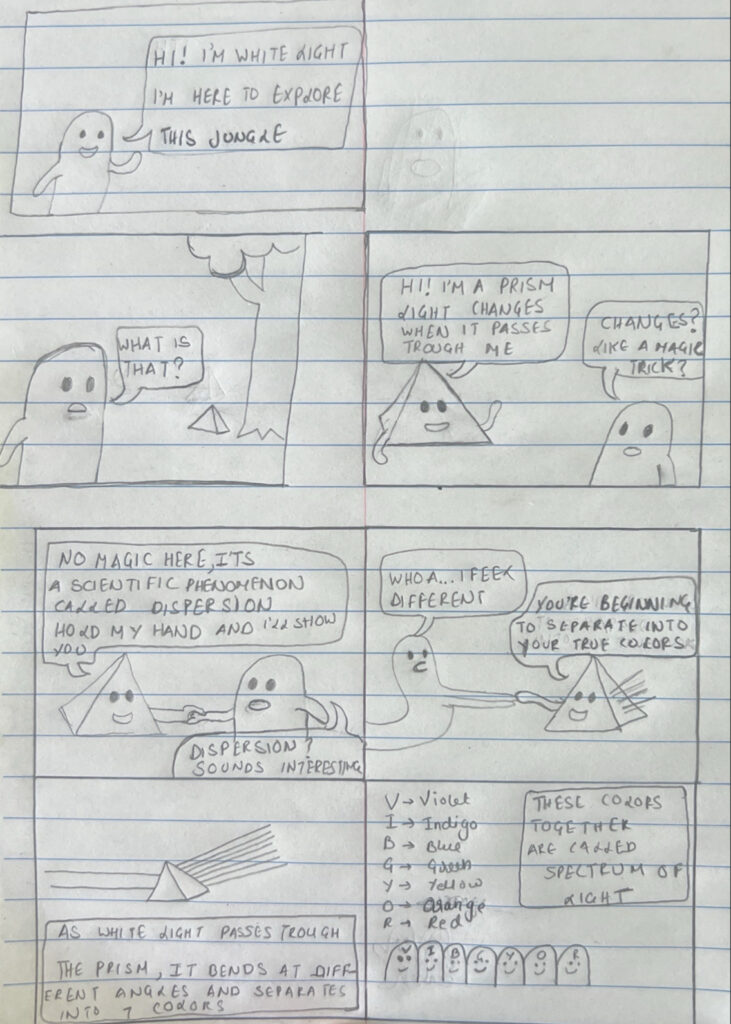
PROTOTYPE
PRINCIPLES APPLIED:
1. Segmenting Principle
Each panel shows one step of the process — curiosity, entering the prism, stretching, splitting, rainbow, and recombination — so readers learn gradually without overload.
2. Dual Coding Theory
The idea of dispersion is taught through both visuals (characters, beams of color, prism, rainbow) and text (narration boxes and simple dialogue). By pairing words with images, readers can form stronger mental connections and better remember how white light splits into seven colors.
3. Personalization Principle
Abstract science is made approachable by turning White Light, the Prism, and the seven colors into characters with simple expressions and dialogue. Using a conversational, story-like tone keeps the explanation engaging and relatable for anyone curious about rainbows or light.
PEER FEEDBACK:
- Emily’s feedback highlighted that she really liked the casual tone of my comic and felt it made the concept more approachable. She appreciated the contrast between the prism and white light characters in my story and said it helped keep the storyline clear and engaging.
She also agreed that I effectively applied principles such as segmenting, dual coding ad personalization.
She suggested that the introduction of the colours after dispersion felt a little anticlimactic and could be made more exciting, perhaps by using multiple panels or giving the colours a more dramatic energy.
She also recommended splitting some of the panels with 2 text boxes into separate ones though she mentioned that the information as it stands is not overwhelming and this is a very light comment. - Simon’s feedback was very positive. He said that my prototype made a complicated science idea easy and engaging and he especially liked the use of characters like White light, Prism and seven colors to make the concept relatable.
He shared his personal experiences where there were stages in his life that developed curiousity about white light for him and how the way my comic is designed makes it suitable for all the readers.
His only suggestion was to trim the text in final few panels so they dont feel too crowded.
Reflect and Refine
What Worked Well:
One of the key strengths of my prototype was the approachable, conversational tone used by characters. By personifying abstract concepts like Dispersion and recombination of white light, the comic became less intimidating and more relatable. The Peer Feedback confirmed that this made the science “simple and meaningful” making it suitable for all the readers.
My peers also appreciated on how I covered the entire concept and related it to naturally occurring phenomenons(which they can relate to more) such as Rainbows.
They also stated that the application of segmenting, dual coding and personalization principles can be clearly seen in the comic.
Incorporating Feedback:
Reflecting on my peer feedback, the reveal of colors after dispersion was noted anticlimatic. I completely agree with that and will make the moment of reveal stronger(all the 7 personified color figures wearing capes etc) and split this part across 2-3 panels.
Staging it this way will create a sense of pacing and build excitement. This will also help with improving more on segmenting principle for some panels at the end.
Revisions:
In my revised draft, In introduced the colors in 2 separate panels with figure wearing capes and a small narration to add a dramatic element to the entrance.
As i thought earlier fixing the above also improved the segmenting principle throughout the comic.
Image Generation
The images for my final comic were created using ChatGPT(Sep 24 version) and Cavna’s Image generator(Sep 24 version).
Sample Prompt:
Characters:
- White Light: Glowing blob like character (round, cream-colored body with blush cheeks dot eyes and small smile). Standing on the ground, facing the Prism.
- Prism: Light-gray, slightly transparent triangular prism with small dot eyes and a gentle smile. Has faint rainbow along its edges.
Visual: White Light is standing on the left, looking at the Prism with curiosity. The Prism is slightly to the right, positioned clearly in the center of the scene so it feels important. Minimal forest/ground background.
Expressions:
- White Light: Curious, head tilted slightly.
- Prism: Friendly, speaking expression.
Text (speech bubbles):
- Prism’s bubble: “Hi! I’m a Prism. Light changes when it passes through me.”
- White Light’s bubble: “Changes? Like a magic trick?”
Issues with Image Generation using LLMs
These language models perform relatively well when there is not a lot of context. Such as the initial panels of my comic where we just have the prism and white light talking.
However as the comic progressed and the visuals became a bit more complex(a lot of elements at once), the quality became inconsistent and I often had to provide multiple prompts to achieve very basic results.
Example:
When I tried to create a panel showing all seven rainbow colors as personified characters (wearing capes) alongside the Prism, the language model repeatedly produced errors. It consistently struggled with accuracy, especially in generating the indigo character, and often mixed up the colors.
If I had known about this limitation earlier, I would have planned differently, since achieving the right images ended up taking much longer than expected and was a really frustrating process. I had assumed these Language models were more reliable for image creation, but this process showed me that their capabilities are still limited.
Biases In the Images
I didn’t deal with any biases as such as the characters in my comics were thought by my own and I was just trying to replicate what I had made for my hand drawn prototype.
My understanding is that being extremely specific with my prompts and the hypothetical concept of personified Prism and White light helped eliminating the biases.
References
OpenAI. (2025). ChatGPT (Sep 24 version) [Large language model].
https://chat.openai.com/chat
Canva. (2025). Canva.(Sep 24 version)
https://www.canva.com/
Theories of Multimedia Learning. EDCI 337. (2025).
https://edtechuvic.ca/edci337/2025/09/05/theories-of-multimedia-learning/